Showing posts with label San Miguel de Allende. Show all posts

Wednesday, May 2, 2012

Iglesias (Churches) of San Miguel de Allende

   One of the many compelling reasons to visit San Miguel de Allende is to explore its churches.  There are over 42 churches within its city limits, many of them centuries old.  They each have their unique history and architecture.  
   San Miguel's oldest church, dating from 1542, lies a about a mile outside the city, where the first community of indigenous people settled.  When a good source of water was discovered further up the hill a few years later, everyone moved to the area that has since become the city's current location.  
  Today, San Miguel's most famous structure and the symbol of the city is its parish church, La Parroquia.  A Gothic design of pink granite (almost Disneyesque) dating from 1880, it's plaza, El Jardin, is the center of activity in the colonial old town where in the evening mariachis play, young people flirt, and tourists snap photos. 
   The city's many churches are a photographer's delight.  While I was there, I never tired of trying to get just the 'right shot' of these colorful architectural structures.  Reading about them and learning their rich history made them even more compelling for me.  Here's some of my favorite photos:


That's Max in front of San Miguel's oldest church, which dates from 1542 and lies a few miles outside the city.

A detail of the carving above the door shows two angels hovering over a (parishoner's?) face.  The church was built by the Spanish to help in converting the indigenous Chichimeca Indians.

The original ofrenda (altar for offerings) used by the first parishioners now sits alone in a field with San Miguel in the distance.

Templo de Inmaculada Concepción de las Monjas

Templo de Inmaculada Concepción de las Monjas

This old church is no longer open, but its four bells, graduated in size from small to large, must have made an imposing sound at one time.

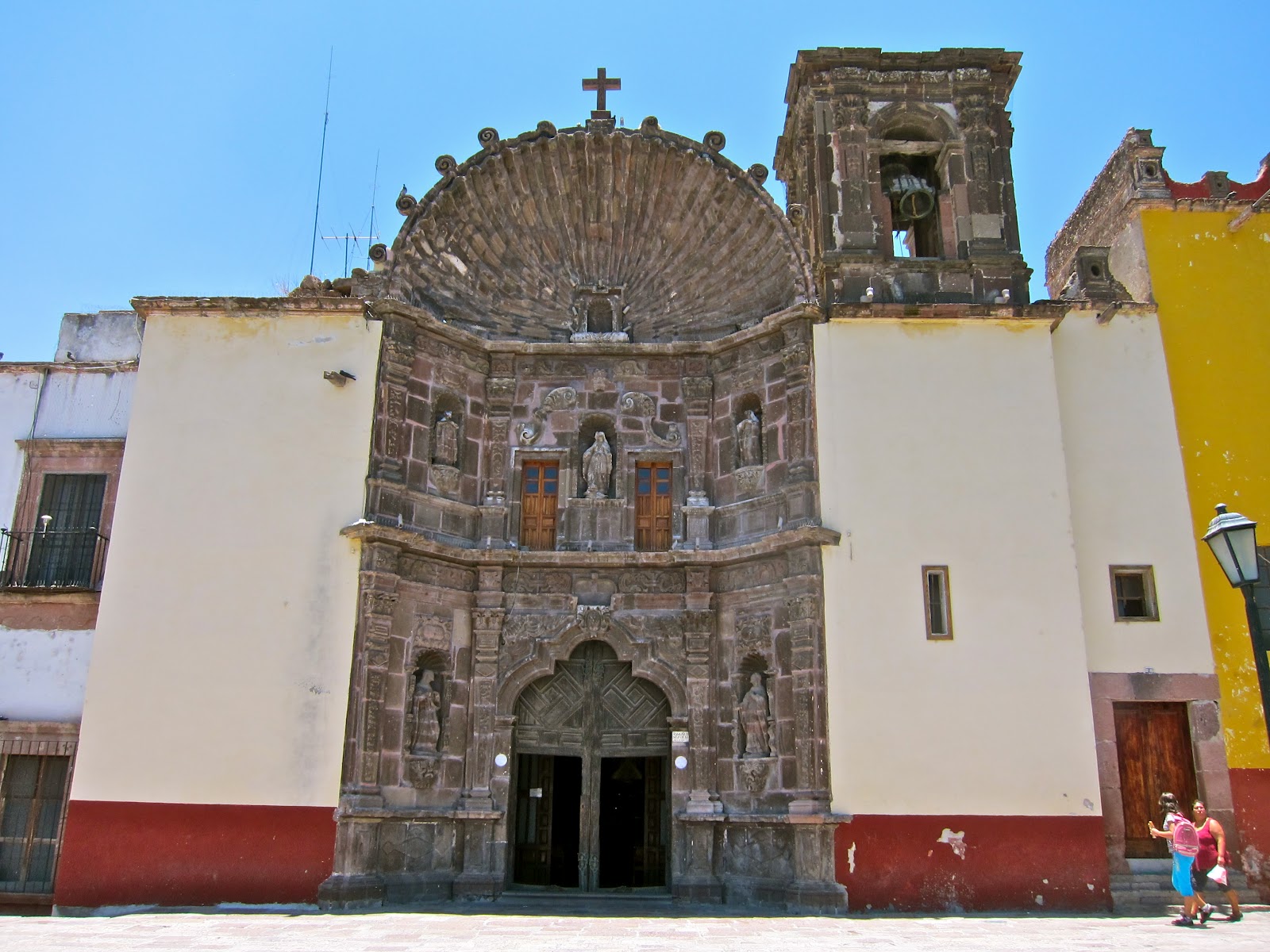
Nuestra Señora de la Salud Iglesia.  In front of this church is the Plaza Allende (see below) where there's always activity--children playing, music, vendors selling snacks.
The Plaza Allende, in front of the Salud Church (above), is a central plaza in the old town.  A block away stands the Templo de San Francisco.

Oratorio of San Filipe Neri
   San Miguel created its Oratorio in 1712 when it invited a famous preacher from the town of Patzcuaro to deliver a series of Lenten sermons.  Don Juan Antonio Perez de Espinoza did such a good job that the Miguelinos invited him to stay and built this church.
Max and I enjoying my friend, Marlene's, roof garden.  Behind us are just a few of the church spires we could view--and hear!  Each morning there would be a concert of bells.
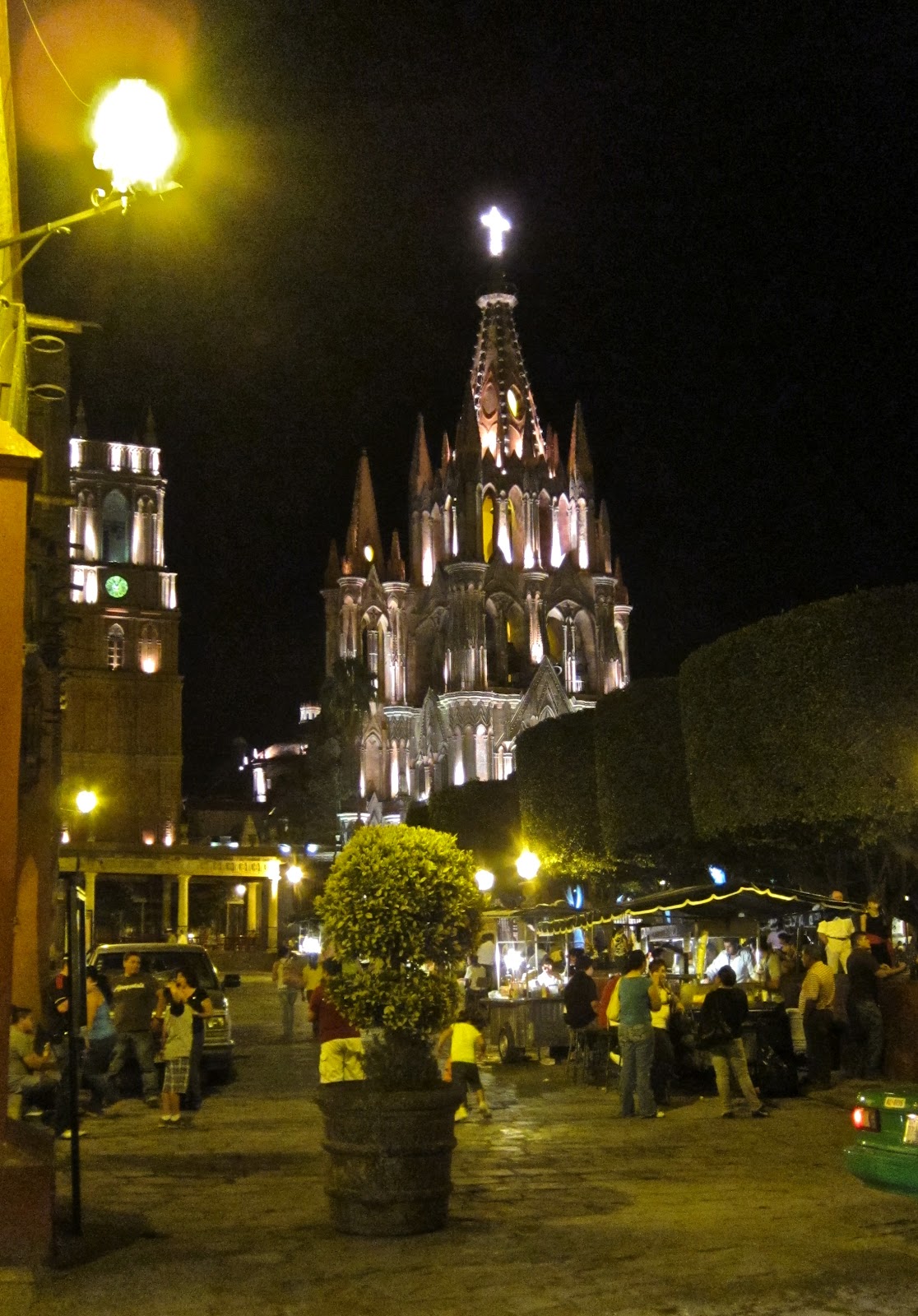
Night view of San Miguel's most famous landmark - its parish church, La Parroquia.
La Parroquia at twilight.  The church fronts on El Jardin, a central park and meeting place for San Miguel residents and tourists alike. 
There were torrential rains on the night of Corpus Christi, which fell on June 23 in 2011.  The streets emptied out, leaving La Parroquia standing solitary and beautiful with its lights and banners.

Monday, December 5, 2011

El Santuario de Atotonilco


   It's Sunday, and Marlene, Max and I are visiting the sanctuary of Atotonilco (meaning 'Place of the Hot Waters').  Before our visit, I wanted to spend some time researching its history because this area is strongly related to Mexico's fight for independence.  

   Here's a short version of its very interesting past.  The sanctuary is a complex of buildings dominated by the original church, founded in 1740 by Father Alfaro.  This area is full of hot springs where public bathing occurred (inappropriately, he believed), and Father Alfaro decided that a religious presence was greatly needed.  The church took over 35 years to build.

   After building this grand church, he commissioned a local artist to paint murals depicting his own instructive verses, with much emphasis on the consequences of leading a sinful life.  The murals and his verses cover the interior walls and ceilings.  There are, in no particular pattern, flowers, fantastic creatures, virgins, Christs, sculptures, gilded mirrors, and altars.  It has sometimes been called the 'Sistine Chapel of the Americas.'

   The church has been designated a UNESCO World Heritage Site, and the complex still functions as a pilgrimage for people coming from all over the country to spend a week of prayer and meditation.

   As we walk from our car up the path to the church, it's market day and there are vendors all along the way, many selling hats, veils, and scarves preparatory to the church visit.  


The outer church is very large.  Inside, it's composed of smaller, separate chapels.

Murals depicting the consequences of sin and Father Alfaro's verses written along the arched openings.

The main chapel of the church

The chapel of the Virgin of Guadalupe

The ceiling of the Chapel of the Virgin

A beautiful, carved wood door from the 18th century

   Father Alvaro built Atotonilco on the spot where he was visited by a vision of Christ.  Coincidentally (?), seventy years later in the nearby town of Dolores, another Father, Miguel Hildalgo, who was leading the fight for independence from the Spanish, was warned of his imminent capture.  He fled immediately towards San Miguel. 

    En route, he stopped at Atotonilco and took the church's image of the Virgin of Guadalupe as his banner, declaring her the protector of the new nation of Mexico.  The image of the Virgin has continued to protect Mexico's independence and individual spirit throughout these many years to the present day.

Father Miguel Hildalgo with the banner of the Virgin of Guadalupe


We are visiting on Sunday, when the path to the church is lined with vendors selling hats, scarves, and souvenirs.  There's also food for sale, like these chickens being prepared on grills fashioned from metal barrels.

This perro (dog) is NOT friendly!  I think he would like to bite all of us.

Wednesday, November 9, 2011

Esteban Valdez, a Living Treasure of San Miguel de Allende

   Marlene, our friend and also a local resident, is tour guide as we set out to Pantoja to find Rancho Las Flores, the home (campo) of Esteban Valdez, San Miguel de Allende's 'master' potter.

   San Jose de Pantoja is a small village outside of San Miguel de Allende.  There are only a few hundred people and it's very rural--roads are dirt and there's dust in the summer and much mud in the winter.  It's understatement to say that Rancho Las Flores is 'off the beaten path.'  In fact, I can hardly believe that Marlene finds it.  There are no signs and all roads look the same to me.


   Esteban Valdez, now in his mid 80s, is a self-taught potter who creates simple clay bowls with primitive, fanciful designs of animals.  His bowls are collected by many and I've read that one of his pieces is part of a collection at the Smithsonian.  These bowls are sold at several locations in San Miguel, but coming to his home and studio to purchase is a special opportunity.


   We learn that to make his bowls, Sr. Valdez uses clay from the nearby river.  He begins to form the clay on a large flat rock that he says was given to him by his father when he was a child.  He then uses molds to form his bowls, and takes a hair from his donkey's tail to trim the edges.  The dark pigment he uses to paint his designs is made from pieces of soft coal mashed and mixed with water.  He fires the pottery in a simple kiln with four brick walls and a sheet metal roof at about 1800 degrees.


   Sr. Valdez says that his grown children are not interested in learning his skills of making  ceramics, so sadly, when he dies, there will be no one to carry on.
        
Marlene in front of the campo of Esteban Valdez.  His vocation as a potter is unique. The town's main industry is brick making.

Max and I get to have our picture taken with Esteban Valdez and his wife

Esteban and his wife at the door of their studio where finished bowls are stored.  He is in his mid 80s and there is no one to carry on his pottery-making tradition.

One of the large bowls, El Pato (The Duck).  E.V. initials are found on many of the pieces

Small bowl - maybe a monkey, maybe a cat, maybe.....

Another large bowl decorated with a whimsical stag
These bowls didn't survive the firing in the kiln.

As we leave Pantoja, we see this lovely iglesia, colorfully decorated; also with a new concrete pad and benches, possibly for multiple activities in the community.


Friday, October 21, 2011

San Miguel de Allende - Friday afternoon cooking class

While language school occupies most of our day Mon - Thurs, our Friday afternoons are free and one of our options is a cooking class taught by Carmen.  In addition to doing administrative work in the school office, Carmen happens to be a fabulous cook!  On a personal note, Max is staying with her and her family during his time in Mexico and considers himself extremely lucky.  Carmen and her husband speak only Spanish in their home and Max's fluency is really improving.  AND, he's also eating wonderful meals three times a day!

Today we're learning how to make Chile Rellenos.  We're also going to make seasoned rice and refried beans.  Regarding the beans, we use canned and then 'refry' in a skillet with more oil.  Heart-stoppingly delicious!  

Carmen is so expert at preparing these dishes that I have to take photos just to remember each of the steps involved.  We students also get to help in prepping, cooking, stuffing, and cleanup.  This entire meal is prepared in the small outdoor kitchen at the school.  Notice the great tile counters (with two burners built in). I've copied Carmen's recipe below in Spanish and translated afterwards into English. 

As you may have already guessed, everything turns out amazing and is completely consumed by all students.  Carmen made preparing this dish seem so easy.  The challenge remains for me to try it at home without her help.

The key to great food - fresh ingredients!
Max is a willing helper 

First browning rice in a little oil before adding water and seasoning

While Carmen's recipe lists only cheese as stuffing, our chiles are 'adapted' and also have sauteed beef, tomatoes, and onion added as filling.  

After burning the skin and 'sweating' in a plastic bag, the skin of the chiles is scraped off with a knife

Then, the chiles are opened and the seeds are removed.


The chiles are stuffed with Ranchero cheese and the meat mixture, then closed with toothpicks and coated with flour.

Here's something more - small tortillas filled with extra meat mixture and fried.

The floured chiles are then dipped in the egg mixture and fried in hot oil.  The warmed tomato salsa is used to cover the chiles and tortillas

Perfecto!!

Great food and great company!!


Chiles Rellenos (Carmen's recipe)

10 Chiles Poblanos
1 Queso Ranchero Grande (1 large block of Ranchero cheese)
5 huevos or 4 si son grandes (5 medium or 4 large eggs)
3/4 kilo de jitomates (1 3/4 lbs  tomatoes)
2 dientes de ajo (2 cloves of garlic)
1 cebolla mediana (1 medium onion)
1/2 taza de harina más o menos (1/2 cup flour more or less)
Aceite para freirlos (Oil for frying)

Se asan los chiles directamente en la flama hasta que la piel se queme.  Se van metiendo en una bolsa de plastico para que suden.  Se les quita la piel, se abre cada uno con cuidado para limpiarlos bien de semillas bajo el agua.  Se escurren, se rellenan con el queso, se enharinan y se dejan en espera.

Roast the peppers directly on the flame until the skin is burned. Then put into a plastic bag to sweat for a few minutes.  Then remove the skin.  Carefully open each chile and clean out seeds under water.  Drain, fill with cheese, flour and then set aside


Se separan las claras de las yemas; a las claras se les agrega una pizca de sal y unas gotas de agua.  Se baten a punto de turron, se les agregan dos yemas y 3 cucharas de harina.  Se 
capean los chiles y se frien en el aceite bien caliente.


Separate the egg whites from the yolks, Add a pinch of salt and a few drops of water to the egg whites. Beat until stiff, then add two egg yolks and 3 tablespoons flour. Coat the peppers in this mixture and then fry in hot oil.


Salsa

Se muelen los jitomates con los ajos y un buen pedazo de cebolla.  En una sartén se frien hasta acitronar, 5 rebanadas más or menos; de cebolla y ahí se agrega el jitomate molido.  Se frie bien, se sazona, con esta salsa se bañan los chiles.  Se acompañan con arroz y frijoles fritos.

In a blender, puree the tomatoes with the garlic and a slice of onion. In a skillet, saute the rest of the onion then add the puree.  To serve, ladle warm salsa over fried chiles and accompany with rice and refried beans.

Friday, September 2, 2011

La Torre Gloriosa

On our first Sunday evening in San Miguel, we 'happened' upon one of my favorite events - a light show on the cathedral.  We were in the central plaza, El Jardin, when all the lights went out and the show began.  This one was amazing, lasting about 15 minutes and choreographed to music. It was difficult to make out all the imaging but afterwards, I found out more information.


2010 marked the 200th anniversary of Mexico's 'El Grito' (Cry for Independence) against the Spanish colonial government.  Cities in the state of Guanajuato (Dolores Hidalgo, San Miguel de Allende, Queretaro, and Guanajuato) are considered the birthplace of the independence movement.  

To celebrate the bicentennial, the French artist Xavier de Richemont created this light show, 'La Torre Gloriosa' (The Glorious Tower), to be displayed on San Miguel's gothic-designed parish church, La Parroquia. The images represent the heroes of the independence movement (San Miguel de Allende is named for one of them - Ignacio Allende), the area's mining history, and Our Lady of Guadalupe, Mexico's most popular religious image. The show continues through 2011. 


It's difficult to capture the event with only the single images below.  Here's also a link to a 30-second video that gives a brief idea:  


The passionate music, the bright colors, and the flow of movement all give me goosebumps!  The Mexican people are extremely proud of their heritage and their heroes.  When I see their historical struggles represented in this show,  it's impossible to not feel their emotion.


Thursday, August 25, 2011

School begins---Learning Spanish

Our first day of classes has arrived.  We're studying Spanish at the Academia Hispano Americana.  This language school began in 1959 and continues to be operated by the daughter of the founders.   Sitting in the courtyard of the school, I'm struck by the thought of modern-day efforts to 'age' and 'distress' furniture, building facades, windows, doors, etc.  Here I am looking at the real thing--a beautiful 17th-century colonial building still functional and currently serving as the perfect home for this language school.

After a short Spanish-proficiency test, Fred is Level 5, Max is Level 3, and I'm at the beginning, Level 1.  Class enrollment is small this session--I have one other classmate, Christopher.  We study grammar and vocabulary in the morning, then an hour each of conversation and pronunciation.  After a lunch break--siesta for some, we come back for our afternoon seminars on Mexican culture and history.  We finish at 6:30 pm--and we have homework.  It's been a LONG time since I've spent this much time attending school and studying.  

The entire session lasts four weeks, however, I notice that some students aren't able to stay that long and are still able to take classes.  While the staff and teachers are friendly and patient, this school is serious about becoming fluent in Spanish and the emphasis is on full immersion.

I'll continue to write more about the school experience.  A lot goes on in four weeks and it's a work in progress.  Here's a link to the school:


Like so many buildings here in San Miguel de Allende, the facade facing the street is relatively simple and plain, then opens up to a beautiful inner courtyard with surrounding rooms.

See what I mean?

Just look at that amazing entry door--all original!   In the afternoons, we listen to Sergio speak in this classroom of Mexican history.  I came to realize just how little I know about this country and its past.  I understand about 65% of his lecture--Max has to fill me in later.  

My classroom


Fred and Max, ready to study Spanish!

My maestra, Teresa, and my Level 1 fellow student, Christopher.